RAG Pipeline Trends That Matter in 2026
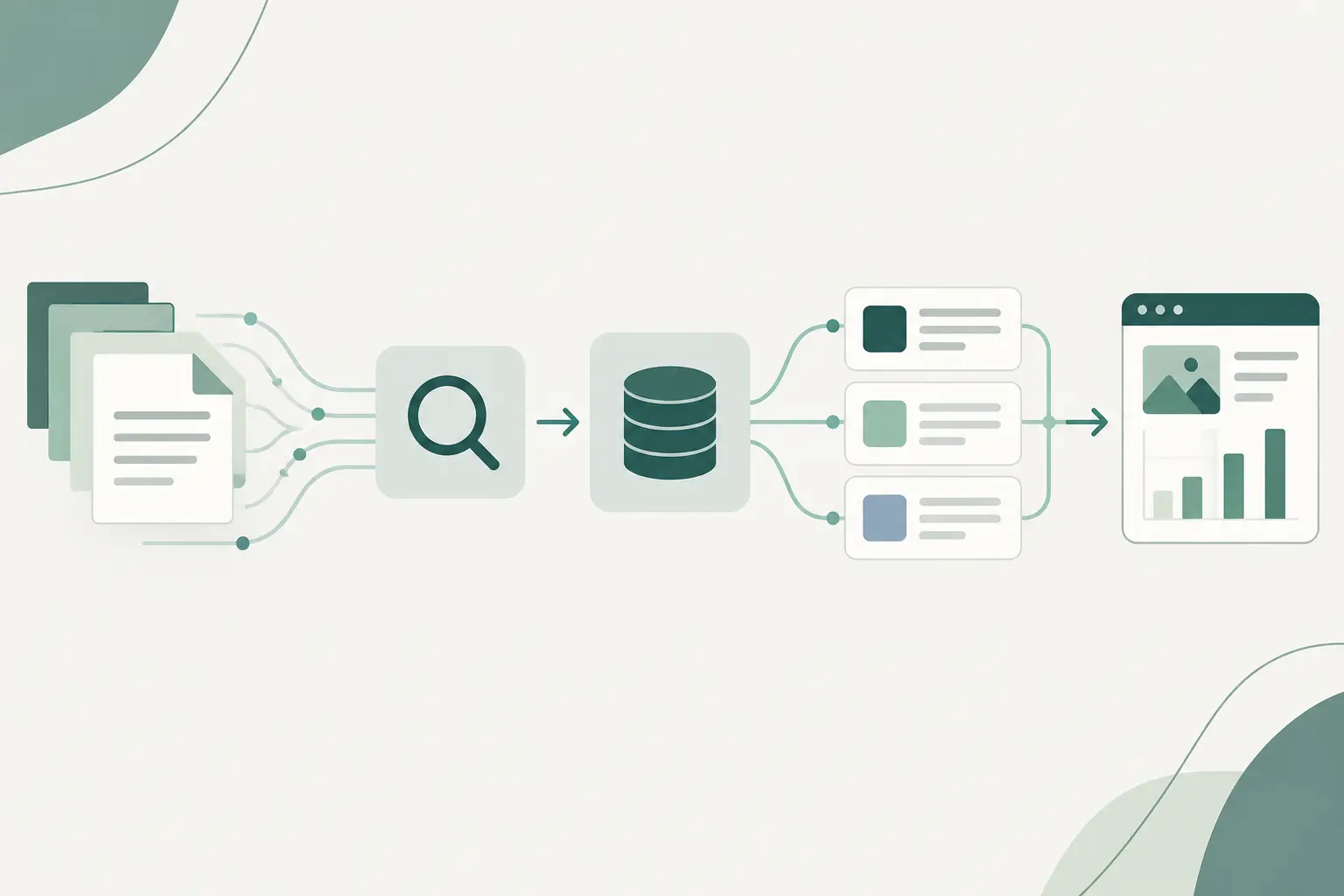
A RAG system can produce fluent answers while retrieving the wrong source, stale context, or an incomplete transcript. The RAG pipeline trends worth tracking in 2026 focus less on swapping models and more on controlling what enters the index, how retrieval works, and how you test failures before users find them.
TL;DR
RAG pipelines are moving from basic vector search toward hybrid retrieval, query routing, and repeatable evaluation. Fresh source data matters as much as embedding quality. For teams working with social video, transcripts need source metadata, timestamps, language data, and a re-indexing path.
RAG pipeline trends are moving past the demo
The old RAG pattern was simple: split documents into chunks, create embeddings, run similarity search, and place the top results in a prompt. It still works for a small, stable document set. It starts to break when the source set includes changing pages, duplicated content, short-form video, multiple languages, and questions that need an exact phrase instead of a semantically similar passage.
The current shift is operational. You need to know which document supplied an answer, when it was indexed, what transformation it went through, and whether that retrieval result was useful.
| Trend | What changes in the pipeline | Why it affects results |
|---|---|---|
| Hybrid retrieval | Vector search runs alongside keyword or lexical search | Exact names, product terms, and quoted phrases are easier to find |
| Source-aware chunking | Chunk boundaries follow the source structure | Context stays attached to the sentence or claim it explains |
| Evaluation sets | Retrieval and answer quality get tested against known questions | You can catch regressions after changing a model or chunking rule |
| Freshness controls | Documents carry timestamps and re-index rules | Old material stops competing with newer source data |
| Query routing | Different questions use different retrieval paths | A lookup query does not need the same handling as a broad research query |
None of these patterns removes trade-offs. A more capable retrieval layer adds moving parts, and evaluation takes time to build. The point is to spend that complexity where your source data and user questions justify it.
Source quality is becoming retrieval control
Retrieval starts before embeddings. A weak transcript, scraped page boilerplate, duplicated record, or missing timestamp can make a good vector database look unreliable.
Treat every item entering your index as a document with provenance. Keep the original source URL or internal identifier, the ingestion date, the content language, and a content hash. The hash lets you skip embedding work when a source has not changed, while the date gives you a way to downrank or remove old context.
Transcripts need more than plain text
Social video is useful RAG input because it often captures what people are saying before the same idea appears in a blog post or help center. It also has quirks: captions may be incomplete, creators change topics mid-clip, and one account can repeat the same hook across many posts.
Do not index one long transcript as a single document. Segment it by timestamp windows or topic changes, then retain enough surrounding text to keep each chunk understandable. A chunk that says "use the second option" is useless if the earlier explanation is in another record.
For public TikTok, YouTube, Instagram, and Facebook videos, ReelScribe can turn a URL into text and fit that ingestion step into an automated workflow through its API or n8n community node. Store the transcript alongside the source URL, platform, language, and ingestion timestamp before it reaches your chunking job.
A normalized internal record can look like this:
{
  "document_id": "social_8f32a1",
  "source_url": "https://example.com/public-video",
  "source_type": "social_video",
  "platform": "instagram",
  "language": "en",
  "published_at": "2026-04-08T14:00:00Z",
  "ingested_at": "2026-04-09T09:18:00Z",
  "text": "Transcript text goes here.",
  "content_hash": "sha256-value"
}
This is an internal document shape, not a request payload for a transcription provider. Keep your provider-specific fields at the ingestion edge. Your retrieval system should consume a consistent record regardless of whether the text came from a social video, CMS entry, support ticket, or product documentation.
Hybrid retrieval wins more useful edge cases
Vector retrieval is good at meaning. Lexical retrieval is good at exact wording. A search for a creator's handle, API field, version number, or unusual product name can fail under vector-only retrieval because semantic similarity is not the same as exact matching.
| Retrieval method | Best fit | Main weakness | Useful guardrail |
|---|---|---|---|
| Vector search | Conceptual questions and paraphrases | Can miss rare exact terms | Filter by source type, language, or date |
| Lexical search | Names, identifiers, quoted phrases | Misses paraphrases and related wording | Add stemming and typo handling where needed |
| Hybrid search | Mixed production queries | Needs score fusion and tuning | Log results from both retrieval paths |
| Reranking | Large candidate sets | Adds latency and cost | Rerank only the top retrieved candidates |
A practical path is to retrieve a candidate set from both vector and lexical indexes, merge the results, and rerank only when the question warrants it. If your corpus is small, reranking every query may be acceptable. If users expect quick answers over a large corpus, use it selectively for broad or ambiguous questions.
Metadata filters matter here. If a user asks about Spanish-language creator feedback from the last month, filtering before retrieval is better than retrieving from every language and hoping the final prompt sorts it out.
Evaluation is moving into the deployment path
Manual spot checks are useful when you first build a RAG feature. They do not tell you what changed after you alter chunk size, replace an embedding model, add a reranker, or ingest 20,000 new records.
Build a small evaluation set from real tasks. Include questions with a single exact answer, questions that require combining two chunks, questions that should return "I do not have enough context," and questions designed to catch stale data. Keep the expected source documents with each test case, not only a model-written ideal answer.
Track retrieval separately from generation. If the right chunk never entered the context window, editing the prompt will not fix the issue. If the right chunk was retrieved but the answer is wrong, inspect context ordering, citation behavior, instructions, and model choice.
Run this set whenever you change ingestion or retrieval behavior. You do not need hundreds of examples to find obvious regressions. Start with the questions that drive support volume, sales research, content research, or internal decisions.
Build an ingestion path you can rerun
A RAG index needs a replayable source pipeline. If a chunking rule changes, you should be able to rebuild documents from stored source text rather than trying to reverse changes inside the vector store.
For an n8n workflow that ingests public social-video transcripts, use this sequence:
- Start with a schedule, webhook, spreadsheet row, or database event containing a public video URL and any campaign or account metadata.
- Pass the URL to the installed ReelScribe community node, then map the returned transcript into your normalized document format. Use the field names shown in your installed node version rather than pasting a guessed workflow export.
- Add a Code node or database step that creates a content hash and checks whether the source text changed since the last run.
- Send changed documents to your chunking and embedding job, with source URL, language, platform, and ingestion date attached to every chunk.
- Write the chunk IDs, document ID, hash, and index version to a database so you can delete or replace old vectors on the next run.
Keep the transcript and its chunks separate. The transcript is your durable source record. Chunks are a derived retrieval format that you can replace as your strategy changes.
The trade-off: smarter retrieval can hide bad inputs
It is easy to compensate for poor source hygiene with another model call. Add a reranker, then a query rewriter, then an answer verifier. That can improve output, but it can also mask duplicated content, missing metadata, and unclear chunk boundaries.
Start with a failure log. For each bad answer, record the query, retrieved chunk IDs, source documents, final context, and answer. After a few weeks, patterns become clear: maybe timestamps are missing, maybe multilingual records are mixed together, or maybe short clips need a different chunk size than long documentation.
Use the next week to ingest one source type with full metadata, create 20 evaluation questions from real work, and compare vector-only retrieval against a hybrid baseline. That test will tell you where your RAG pipeline needs work before you add more components.
Ready to turn your videos into text?
Start with 25 free credits — no credit card required. Works with TikTok, YouTube, and Instagram.
Start Free Transcription →Also see: RAG pipeline video transcript example that works · Best Transcript Inputs for RAG That Retrieve Well · How to Send YouTube Transcripts to RAG Systems · 10 Best Tools for Video Repurposing in 2026